Californians assume a sale resets the tax bill, because at home it does. Bring that habit to Indiana and you can get the number wrong in both directions.
Most pro formas carry the seller's property tax bill straight into year one. It's the easiest number to grab. It's also one of the most likely to be wrong after you close.
The common warning is that a sale triggers an automatic reassessment to the purchase price. That's true in some places and flatly false in others. In two of the states we watch most closely, Indiana and Ohio, the rules work very differently.
Don't underwrite the seller's tax bill. Underwrite the rule that will set yours.
Indiana: no sales chasing, but values still move
Indiana assessors are directed by rule to avoid "sales chasing," meaning revaluing a property just because it sold. A purchase price above the assessed value is not, by itself, a trigger.
Values still move. Indiana trends assessments every year based on market data and runs a cyclical reassessment. If the market has moved, the assessed value follows, sale or not.
Indiana also has a circuit breaker. For residential rental property, including apartment buildings, the tax bill is capped at 2% of gross assessed value. The cap limits the tax, not the value. Two practical notes:
The cap moves with assessed value. If trending pushes value up, the ceiling rises with it.
Local budgets under pressure from the caps can push rates toward the ceiling.
Ohio: the sale price is evidence
In Ohio a recent arm's length sale is strong evidence of value. The county auditor can use it at the next reappraisal or update. A complaint at the board of revision can also push the value toward the sale price.
The biggest historic risk was school boards filing those complaints after a sale. House Bill 126, effective July 2022, narrowed that sharply. A school board can now file only when the price beats the auditor's value by at least 10% and at least $500,000 (both indexed), and only after passing a resolution and notifying the owner.
Most 4 to 70 unit sales fall under that $500,000 gap. The exposure doesn't disappear, though. It moves to the next reappraisal cycle.
California, for comparison
California is the clearest case of reassessment on sale. Under Proposition 13, a change of ownership resets the assessed value to market, usually the purchase price. The tax is 1% plus local bonds, roughly 1.1% to 1.3% of price, and the value can rise only 2% a year after that.
That is why California buyers put the reset in every model. It is the right habit at home and the wrong rule in Indiana.
California. A sale resets value to the price. Effective rate 1.1% to 1.3% of price. Typical price per door $323,900 (Orange County median). Tax per door about $3,900 a year.
Indiana. No reset; sales chasing is barred. Effective rate 1.01% statewide, with rentals capped at 2% of assessed value. Typical price per door $90,000 (our target). Tax per door $1,070 to $1,800 a year.
Ohio. The sale is evidence, and challenges are limited. Effective rate 1.43%. Typical price per door $104,300 (Cincinnati median). Tax per door about $1,490 a year.
National. Reset rules vary by state. Effective rate about 1.0%. Average price per door $206,982. Tax per door about $2,090 a year.
The rate can be higher in the Midwest. The bill per door is lower, because the door costs a third as much.
Other states
Some jurisdictions do move quickly toward sale prices, and appraisal districts in some growth markets are aggressive. The answer is local. Before an offer, we find out which kind of jurisdiction we're in.
What the miss costs
Here is an illustrative 30 unit building with $230,000 of NOI on the seller's statement, which includes a $45,000 tax bill.
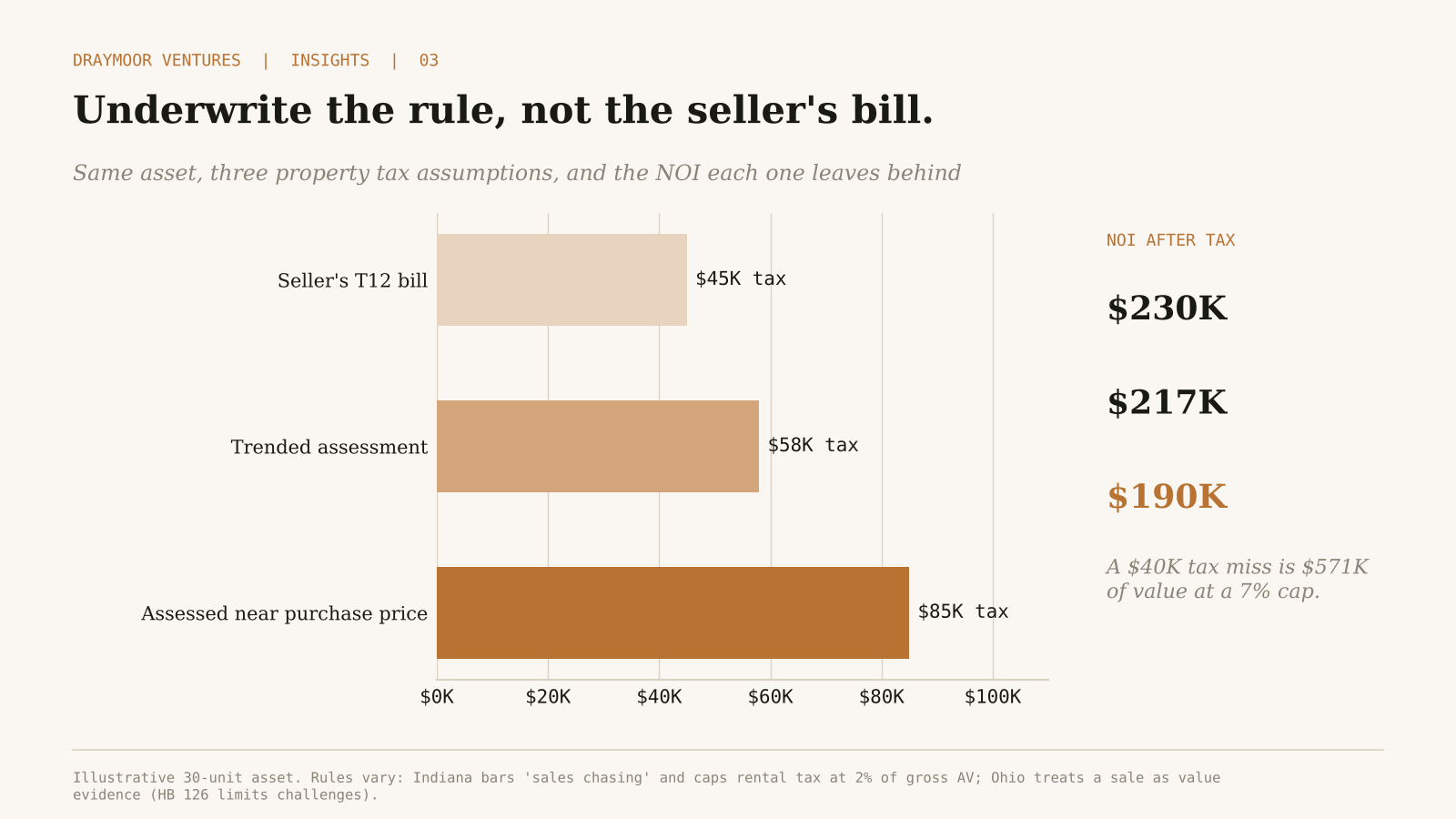
If trending lifts the bill to $58,000, NOI falls to $217,000. If the assessment moves near the purchase price and the bill becomes $85,000, NOI falls to $190,000.
That $40,000 difference isn't small. At a 7% cap rate it's about $571,000 of value. On a conservative loan it can be the difference between 1.25x coverage and a deal that doesn't qualify.
How we underwrite it
Pull the actual bill and the assessed value, not the line on the seller's operating statement.
Learn the local rule. Does a sale reset value, is it evidence, or is it ignored? When is the next reappraisal?
Model the tax two ways. Once on current trending and once with the assessment at or near our price. The deal has to work on the second.
Check for abatements and caps that expire after a sale or a set number of years.
Our rule
The deal has to cover debt at 1.25x with taxes underwritten at the higher of the two cases. If it only works on the seller's bill, we're buying the seller's tax basis, not the building.
Bring us the real numbers
Have a property in Indiana, Ohio or one of our other target markets? Send the T12, rent roll and the current tax bill to steven@draymoorventures.com.
Source and data note
Indiana "sales chasing" rule: 50 IAC 27-11-2.
Indiana circuit breaker caps: Indiana DLGF fact sheet.
Ohio HB 126 (2022): Frost Brown Todd analysis.
California Prop 13 rules: San Luis Obispo County Assessor. Effective rates: Tax Foundation and Ownwell, 2026 (Indiana uses 1.19% Marion County median to the 2% cap). Prices per door: Northmarq Q1 2026 and 2025, MSCI RCA Q2 2026. The 30 unit example is illustrative. This is general information, not tax or legal advice. Confirm with a local assessor or tax counsel before relying on it.