Everyone is calling 2026 a buyer's market for distressed apartments. Most of those buyers are about to make the same mistake the sellers made.
A lot of apartment buildings were bought in 2021 and 2022 on a simple plan. Borrow short, renovate fast, raise rents, then refinance into cheap permanent debt. The plan assumed the exit would look like the entry.
It doesn't. The Mortgage Bankers Association puts 2026 commercial real estate maturities at roughly $875 billion. Most of that is ordinary bank and life company debt that will roll without drama. The pain is concentrated in one corner: floating rate multifamily bridge loans from the 2021 to 2022 vintage. Distress in CRE CLOs, the vehicles that hold much of that paper, reached 28.2% in August.
The business plan can work and the deal can still fail. That is what a bridge reset looks like.
What changed between origination and maturity
When those loans were written, the index (LIBOR, then SOFR) sat near zero. A typical bridge coupon landed around 4% all in. One public bridge lender reported a 4.43% weighted average coupon at the end of 2021.
In early October 2026, SOFR was 3.87%. Put a 4.75% spread on top and the renewal rate is about 8.6%. On an interest only loan, that roughly doubles the debt service with no change to the building.
Here is an illustrative 40 unit asset carrying a $3.6 million bridge loan.
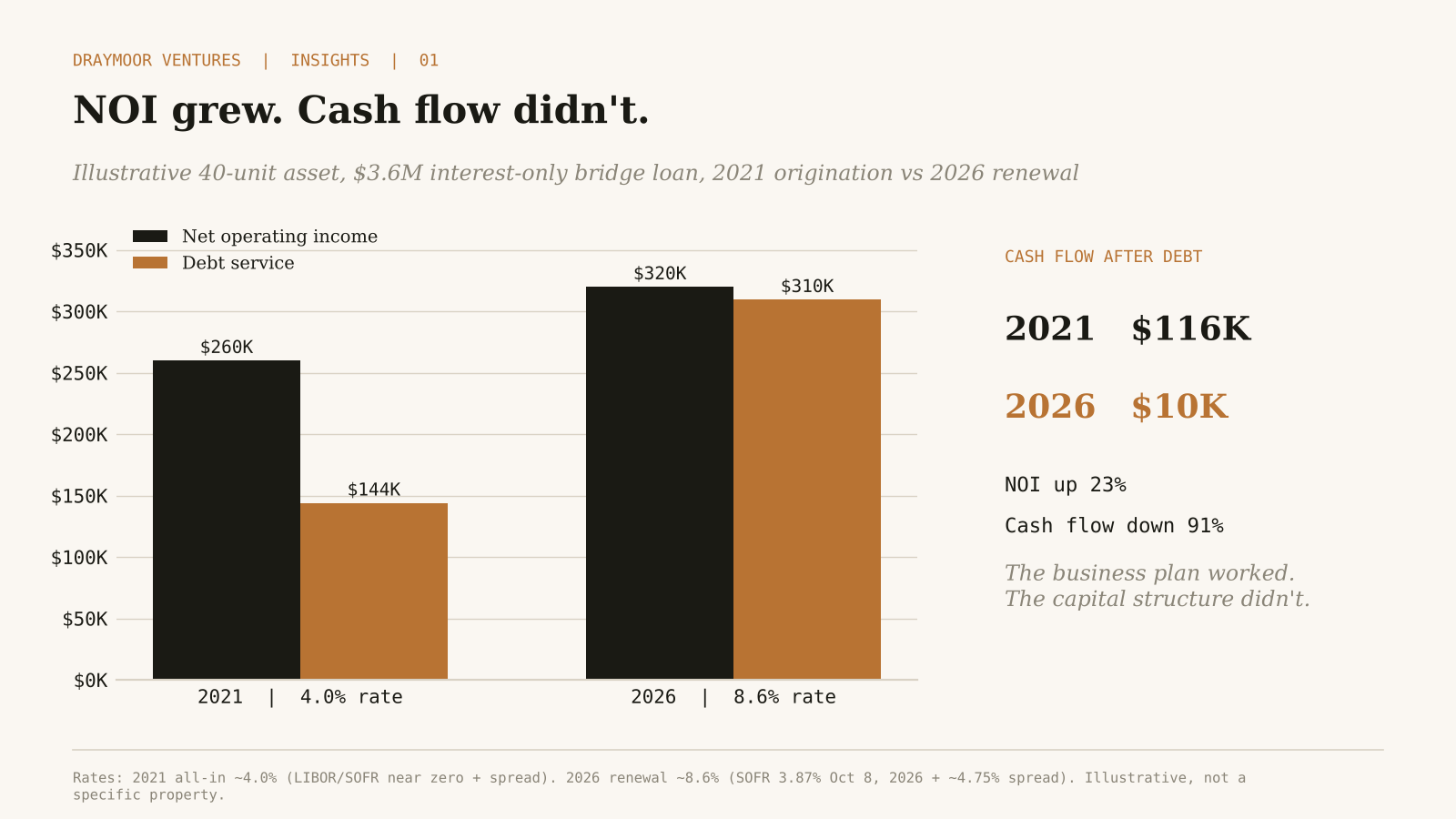
In 2021 the property earned $260,000 of NOI against $144,000 of interest. That is $116,000 of cash flow. By 2026 the operator did the job. NOI is up 23% to $320,000. But interest is now about $310,000, and cash flow is down 91% to roughly $10,000.
Ten thousand dollars on a 40 unit building is one bad roof leak or two evictions away from negative.
Lenders size to what happened, not what's planned
The second problem is how the replacement loan gets sized. Permanent lenders underwrite trailing twelve month actuals. They apply their own vacancy, their own reserves and their own expense floors. A pro forma that shows where rents are going does not count. A T12 that shows where rents have been does.
That means an owner who is a few months behind on the business plan gets sized on the old numbers, at today's rates.
The three exits
An owner facing a bridge maturity usually has three choices.
Cash in refinance. Pay down the loan until it fits permanent lender limits. This works if the sponsor has the equity. Many don't.
Rescue capital. Bring in preferred equity or mezzanine debt to fill the gap. It keeps the asset, but at a cost of 12% to 15% or more, and it sits ahead of the original investors.
Sell. Take the market price today, before reserves run out and the decision gets made by someone else.
None of these are good outcomes for the original equity. All three are better than waiting.
Why this matters to a buyer
Bridge distress is where some of the best basis of the next few years will come from. Owners who need to sell, lenders who need to resolve loans, and properties that are operationally fine but capitally broken.
But a motivated seller is not the same thing as a good deal. The mistake we expect to see again is buyers taking these assets with new short term floating debt, betting rates and cap rates come back in time. That is the same bet that put these properties up for sale. The question we ask is whether the building works at today's rates on today's numbers, with no rescue assumed.
Our rule
We buy for cash flow and we plan to hold. That means fixed rate or long term debt, sized to trailing numbers, with coverage of at least 1.25x on day one. We do not take on financing that needs a refinance to survive. If the deal only works with a short term loan and a better market, it doesn't work.
Bring us the stressed ones
If you own or represent a 4 to 70 unit property facing a maturity, we would rather talk early than late. Send the T12, current rent roll and the loan terms to steven@draymoorventures.com. A quick, honest read costs nothing.
Source and data note
2026 maturity volume: Mortgage Bankers Association.
CRE CLO distress rate, August 2026: CRE Daily.
2021 bridge coupon example: ACRES Commercial Realty 2021 10-K.
SOFR 3.87% as of October 8, 2026 (SOFR data). The spread and the 40 unit example are illustrative and do not describe a specific property.